
Holiday Boundaries: Because December Is Basically the Olympics of Emotional Endurance
Yay! Thanksgiving is behind us, which means we have survived the first big test of the season. Now comes the rest of it. December has its own special blend of joy, obligations, traditions, expectations, financial strain, and that one relative who thinks privacy is just a suggestion.
It is a wonderful time of year and also an exhausting one. Which is why this is the perfect moment to talk about boundaries. Not the theoretical kind. The useful kind. The kind of boundaries that protect your time, energy, money, mental health, and sense of humor.
We have covered the psychology of boundaries in a previous article, Boundaries: A Little Less Talk and a Lot More Action, including how they protect your mental health, strengthen relationships, reduce stress, and make you feel more grounded and respected.
But holidays raise the stakes. There are more gatherings, more potential conflicts, more pressure to “make everything perfect,” and more opportunities to prioritize everyone else’s happiness over your own.
So, you might want to start December with a plan.
Why Holidays Make Boundaries Harder
Holidays ask you to juggle family dynamics, traditions, travel, spending, and the fantasy version of yourself who can cook, host, attend everything, stay cheerful, and remain emotionally unbothered all at once. That is a lot to ask of any human.
Holiday pressure often comes from comparing yourself to others and feeling like you have to keep up. Even though you know that your worth is not tied to whether your home looks like a magazine or whether you attend every event, holidays and family gatherings may help you forget that.
On top of that, many families have topics that go from zero to awkward faster than you can say pie. Research shows that questions about relationships, career choices, appearance, and children are among the most common triggers. Some cultures expect you to defer to elders, which makes direct boundary setting tricky.
If you have ever left a holiday gathering feeling wrung out like a dishcloth, that is why.
Step One: Decide What You Can Reasonably Handle This Month
Think of this as your December health plan. What is your energy budget for the season? How many events feel good rather than draining? How much travel feels manageable? What financial commitments are realistic?
Your holiday boundaries source puts this first for a reason. Staying honest about your limits prevents burnout and resentment later.
A simple way to start is to ask yourself a few questions:
- If no one’s feelings were involved, what would I choose to attend?
- What do I look forward to versus what I endure?
- What helps me feel grounded?
- What overloaded me last year?
Your answers will help you shape your boundaries. Make some decisions and write them down.
Step Two: Communicate Early and Clearly
You do not need to deliver a proclamation to the family group chat, but letting people know your plans before emotions run high is your best strategy.
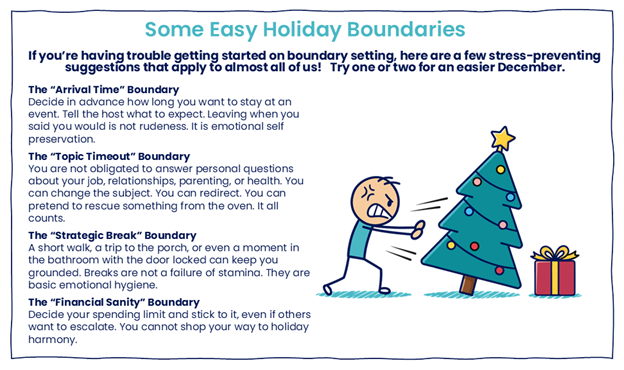
Clear communication is one of the strongest tools we have for protecting our well-being. Saying “I can stay until nine” or “We’re keeping gifts small this year” is respectful, efficient, and clear.
It also helps manage expectations. If you know you become impatient after two hours, let people know you have other plans afterward. This is not rude. This is honest.
And honesty is far less stressful than pretending you can do everything.
Step Three: Learn to Say “No” With Less Guilt
A reminder that deserves repeating: “No” is a complete sentence, even during the holidays.
You are not required to attend every event, join every gift exchange, make every dish, or stay longer than you want. If you practice saying “no” in low-stakes situations, the big ones feel easier later.
If “no” feels too sharp, try any of these holiday-friendly versions:
- “I would love to see you, but I cannot make that work.”
- “I can come, but only for a couple of hours.”
- “That sounds fun, but I need a quiet night.”
These are polite and firm, which is exactly the goal.
Step Four: Use Creative Boundaries When Direct Ones Feel Too Hard
In some families or cultures, directness can come across as disrespectful. Researchers note that indirect boundaries can work just as well.
If someone is asking intrusive questions, you can change the subject. If a topic is “radioactive,” you can redirect the conversation. If you feel overwhelmed, you can take small breaks. A quiet lap around the block or even texting a friend from another room can lower your emotional temperature.
These strategies are not avoidance. They are tools for maintaining your peace.
Step Five: Expect Some Pushback (and Don’t Take It Personally)
When you change familiar patterns, people sometimes resist. This is normal. It does not mean you are wrong to set the boundary.
Pushback may create feelings of guilt. But that feeling does not mean your boundary is unreasonable. It means you are learning a new skill.
Other people’s reactions are about them. Your number one responsibility is to take care of yourself.
Step Six: Make Room for Flexibility and Compassion
Boundaries are not rigid walls. They are adjustable tools that help you stay healthy. You can be flexible when it feels right or firm when it is necessary.
Let’s face it, traditions evolve and we do not need to do everything exactly the way we always have. It is okay to simplify. It is okay to opt out. It is okay to start new traditions that reflect where we are now.
Compassion is part of the process, especially compassion for yourself.
The Bottom Line
December is full of opportunities to enjoy, connect, celebrate, and reset. Boundaries help you enjoy more of the good stuff and less of the stress. They help you protect your peace, your time, your money, and your relationships. They also help you show up as your best self for the people you love.
And if this year’s gatherings still feel like a competitive sport, know that you are not alone. Boundaries are an ongoing practice, not a one-time event. Start with one or two and build from there.
