
Understanding Love Languages Can Boost All Your Relationships
We’re closing in on Valentine’s Day, a day that has a way of reducing love to flowers, chocolate, and dinner reservations. But long before the prix fixe menus appear, there’s a quieter question worth asking:
What makes you feel loved? And its corollary: What makes your loved ones feel loved?
It’s worth understanding the answers to these questions, and not just on Valentine’s Day. The way we show each other warmth and affection drives every relationship in our lives. But Valentine’s Day is a good excuse to take a closer look 😉.
One way of decoding how we feel about this sort of thing is by looking at our love languages. The idea of “love languages” was popularized by marriage counselor Gary Chapman in his book, The 5 Love Languages. His premise is simple: people tend to give and receive love in different ways. When those ways line up, relationships feel easy. When they don’t, we can miss each other completely, even when we’re both trying.
And despite the name, this isn’t just about romance. The same patterns show up with friends, children, parents, colleagues, and even patients and caregivers.
So, what are the languages?
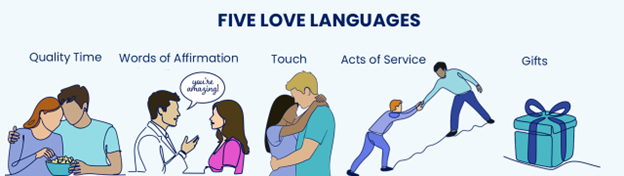
Quality Time
This is focused attention. Undivided presence.
Not sitting next to each other while scrolling. Actually talking. Walking. Cooking together. Listening without multitasking.
When this language is strong, distractions can feel like rejection. Time is the currency.
Words of Affirmation
This language is verbal. Encouragement. Appreciation. Saying the good thing out loud.
For someone who leans this way, “I’m proud of you,” or “I appreciate how hard you worked on that,” lands deeply. Silence, on the other hand, can feel like indifference.
In everyday life, this might look like thanking your child for unloading the dishwasher without being asked, texting a friend before a big meeting, or telling a colleague specifically what they did well instead of assuming they know.
Physical Touch
This includes hugs, hand-holding, sitting close, or a reassuring hand on the shoulder.
For some people, touch regulates stress and signals safety. For others, it may be pleasant but not central.
Acts of Service
Here, actions truly speak louder than words.
Making dinner. Picking up the prescription. Taking the car in for an oil change. Doing the thing that makes someone else’s day easier.
If this is your primary language, empty compliments can feel nice but incomplete. Real love shows up as help.
Gifts
This one is often misunderstood. It is not about price tags. It is about thoughtfulness.
A favorite snack picked up at the store. A book that made you think of someone. A postcard from a trip.
For people wired this way, the gift represents “I was thinking about you when you weren’t in the room.”
And that brings us to an important question…
Does everyone use all of the love languages?
Yes. Most of us appreciate all five to some degree. The idea is not that you only “speak” one language. It is that you usually have one or two that feel most meaningful. They hit differently. They fill your tank faster.
How do you figure out yours?
Start by noticing patterns.
When do you feel most appreciated?
What do you complain about most often?
What do you naturally do for others?
If you frequently think, “I wish they would just say thank you,” words of affirmation may matter to you. If you tend to cook, fix, organize, and handle logistics for the people you love, acts of service may be your instinctive language.
There are online quizzes based on Chapman’s framework, but simple self-observation works just as well.
What can you learn about yourself?
Sometimes your love language reveals what you did not consistently receive earlier in life. Sometimes it reflects how you are wired temperamentally. It can also highlight your stress triggers. If quality time is your primary language, constant busyness may feel especially painful. If physical touch matters to you, emotional distance may register physically.
Understanding this can make your reactions feel less mysterious.
Why does this matter outside romance?
Because mismatches happen everywhere.
A manager who values acts of service may show appreciation by lightening your workload. An employee who values words of affirmation may leave that interaction feeling unseen.
A parent may provide endless practical help. A child may just want uninterrupted time.
When we assume everyone values what we value, we risk loving people in ways that do not land.
Should you try to speak other love languages?
Absolutely.
This is not about demanding that others adapt to you. It is about expanding your range. If your partner lights up when you initiate quality time, it is useful to know that. If your friend feels cared for when you text encouragement before a tough day, that is a simple, powerful adjustment.
Think of it less as changing who you are and more as becoming multilingual.
What if your partner speaks a different love language?
That is common.
It does not mean you are incompatible. It means you may need translation.
If you show love through acts of service but your partner needs words of affirmation, your steady help may go unnoticed unless you also say the thing out loud. If you crave physical touch but your partner values quality time, scheduling intentional time together may matter more than spontaneous affection.
The goal is not to keep score. It is to become more fluent in each other.
Valentine’s Day may spotlight romance, but the bigger opportunity is awareness. When you understand how you and the people around you feel valued, everyday interactions change. Small shifts. Clearer communication. Fewer hurt feelings that start with “But I was trying.”
Love is not only about intensity. It is also about translation and understanding. And that is something we can practice all year long.
