
Creatine Is Everywhere — Here’s What to Know
If you resolved to work out more this year (or simply scroll fitness content more aggressively) you’ve probably seen creatine everywhere.
It’s been around for decades, it’s suddenly having a moment on TikTok, and it’s being credited with everything from muscle growth to brain health to menopause relief. That’s a lot to put on one powder.
Creatine has been the subject of a wide variety of studies, and many of those hyped up claims have been scientifically tested. So, let’s break it down, review the research, and separate what creatine does from what the hype suggests.
What exactly is creatine?
Creatine is a compound your body already makes, primarily in the liver and kidneys. You also get small amounts from foods like red meat and fish.
In your body, creatine is stored mostly in muscle cells, where it helps produce adenosine triphosphate (ATP), the molecule your cells use for quick bursts of energy. Think sprinting, lifting, jumping, or any short, high-intensity effort.
That’s the key: creatine is about short-duration power, not endurance or fat loss.
How Creatine Helps (With Good Evidence)
Creatine is one of the most well-studied supplements in sports medicine, and its benefits are pretty specific:
- It can help you lift slightly heavier weights or do a few more reps
- It can improve performance in short, high-intensity workouts
- Over time, that extra output can support increased muscle mass
- It may help reduce fatigue during repeated bursts of effort
In short: Creatine helps you train harder, which can lead to increased strength gains if your workouts are consistent.
What Creatine Does Not Do
Despite some bold claims online, creatine does not:
- Automatically build muscle without resistance training
- Burn fat
- Replace protein
- Act as a general energy booster for daily life
- Work like a hormone or a stimulant
Creatine also isn’t a shortcut. If you’re not strength training or doing high-intensity workouts, you won’t see any difference in your body or your energy level.
What about brain health and menopause?
This is where things get interesting — and where nuance matters.
There is early and emerging research exploring creatine’s role in brain energy metabolism and potential cognitive benefits, especially under stress or sleep deprivation. However, this research has not produced results strong enough to support broad claims.
Similarly, some researchers are studying creatine in the context of menopause, particularly around muscle preservation and fatigue. While it may be a promising area, there’s not yet enough high-quality evidence to say creatine meaningfully treats menopause symptoms.
While news producers and influencers are happy to broadcast on the suggestion of efficacy in studies, the fact is that, to date, creatine has not been proven boost brain health or reduce menopause symptoms directly. The only proven benefit is creatine’s ability to enhance physical performance during short, intense exercise.
Who might benefit from creatine?
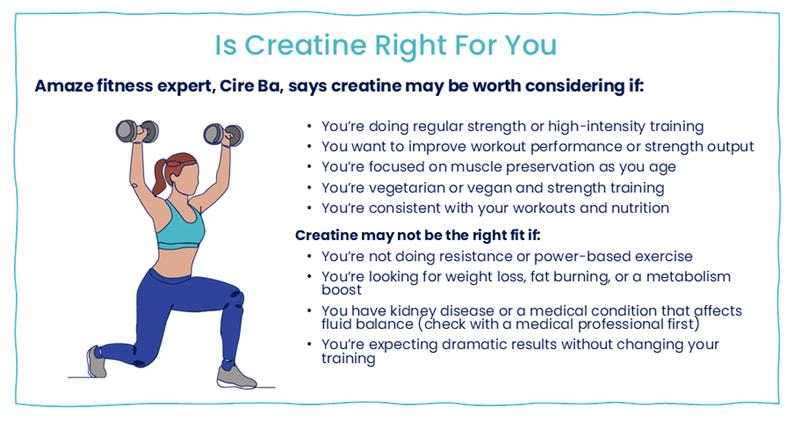
Creatine may be useful for:
- People doing regular strength or power-based training
- Older adults looking to preserve muscle mass while strength training
- Athletes involved in sprinting, lifting, or high-intensity interval training
- Vegetarians or vegans, who may have lower baseline creatine stores
It’s less helpful for endurance athletes and people who aren’t strength training.
How is creatine usually taken?
Cire suggests that you stick to creatine monohydrate, the most studied and reliable form.
- Typical dose: 3–5 grams per day
- There isn’t a drastic difference in taking the supplement before or after a workout
- Make sure to drink adequate fluids
- Optimal efficacy happens a few weeks after consistent ingestion by letting the supplement build up in your system
Creatine can cause mild water retention in muscles, especially early on. That’s normal and not the same as fat gain.
Creatine Forms: Powder, Capsules, Gummies — What’s the Difference?
Creatine is available in several forms, and they mostly differ in convenience and cost, not in how well the creatine itself works. The active ingredient (usually creatine monohydrate) is what matters most. The rest is packaging.
Here’s a quick breakdown:
Powder (the classic)
What it is: Creatine monohydrate in loose powder form, usually unflavored or lightly flavored.
How you use it: Mix with water, juice, or a protein shake.
Pros:
- Most cost-effective per gram
- Easy to dose consistently (standard is ~3–5 g/day)
- Often micronized for better solubility
Cons:
- Some people don’t like mixing or carrying a scoop around
- Slight grittiness is possible if it doesn’t dissolve fully
Best for: Most serious exercisers, especially those taking it daily with workouts.
Capsules/Tablets
What they are: Creatine in pill form.
How you use it: Swallow with water like any supplement.
Pros:
- Very convenient — no mixing
- Easy to take on the go
Cons:
- Usually more expensive per gram
- You may need multiple pills to reach an effective dose (3–5 g), depending on capsule size
Best for: People who don’t like powders or who want maximum simplicity.
Gummies/Chewables
What it is: Creatine blended with a gummy or chewable form.
How you use it: Chew like candy or a vitamin.
Pros:
- Easy and tasty
- Good for people with trouble swallowing pills
Cons:
- Often less creatine per serving
- May contain added sugar or other ingredients
- Can be more expensive per gram of creatine
Best for: Those who prioritize taste/texture, but not ideal for regular dosing.
Powder and capsules are the most practical options for most people. Here’s why:
- Effectiveness: All forms can work if they deliver the same amount of creatine monohydrate — so it isn’t about the form per se, it’s about how much creatine you actually get.
- Cost: Powder typically offers the best value per effective dose.
- Dosing accuracy: With powder or capsules, it’s easiest to consistently hit the recommended 3–5 g/day.
- Sugar/Fillers: Gummies often include added sugars or flavors, which aren’t necessary for performance benefits.
Choose the form you’ll actually take consistently, but don’t choose gummies if your priority is a clean, cost-effective performance supplement, especially if you’re planning to take creatine every day.
What to Look For in a Creatine Supplement
Because supplements aren’t tightly regulated, quality matters.
Look for products that are:
- Creatine monohydrate only (no proprietary blends)
- Third-party tested by organizations like NSF Certified for Sport, USP, or Informed Choice
- Free from added stimulants or unnecessary ingredients
If a label promises dramatic transformations, it’s overselling.
The Amaze Takeaway
Creatine isn’t magic — but it is one of the few supplements with solid evidence behind it, when used for the right purpose.
If you’re lifting, training hard, and want a small performance edge, it may be worth considering. If you’re hoping for weight loss, hormonal balance, or a brain boost, the science just isn’t there yet.
