
It Improves Strength, Posture, Flexibility, and Makes You Better at Sports (No Kidding!)
Pilates is more than one hundred years old but it’s having a moment. This year was the third in a row that Pilates was ranked the most popular workout globally.
Studios are booked and are having trouble hiring enough trained Pilates instructors to keep up with demand. And while the phrase “Pilates girl” has entered the cultural vocabulary, elite male athletes like LeBron James, Tom Brady, Tiger Woods, and Cristiano Ronaldo have been using Pilates to up their respective games.
Pilates looks pretty tame, but it has humbled the most fit among us. By contrast, Pilates is an all-around workout accessible to almost anyone. In fact, Pilates has quietly become the workout of choice for people across all ages and fitness levels, because it addresses every key aspect of fitness: endurance, flexibility, balance, mobility, and strength.
If you haven’t joined the ranks of Pilates-lovers, read on. Your life might be about to change.
What is Pilates?
Pilates is a form of strength training, but it doesn’t look like what most of us think of as strength training. There are no heavy barbells or explosive movements. Instead, it focuses on controlled, precise exercises designed, first and foremost, to strengthen your “core.” Not just your abs, but your entire trunk: back, hips, pelvic floor, and deep stabilizing muscles.
Pilates draws from both Eastern and Western ideas about health and strength, as well as the mind-body connection. Movements and breath are controlled, but there are no poses like there are in yoga.
The Body Benefits
Pilates tends to deliver in ways that show up outside the workout itself.
It improves posture, which matters more than most of us realize, especially if you spend a lot of time sitting. It strengthens the deep muscles that support your spine. Many people with back pain find a great deal of relief in Pilates.
While Pilates has a strong core focus, the movements are designed to enhance stability, balance, flexibility, and mobility, which become increasingly important as we age. There’s also a coordination component. Because the movements are slow and intentional, you’re training your brain and body to work together more efficiently. Over time, that can translate into better performance and fewer injuries in other sports and other workouts.
Types of Pilates
Pilates can be practiced in a variety of ways ranging from simple and accessible to equipment-heavy. There are a few different formats.
Mat Pilates is the most accessible. It uses your body weight and sometimes small props like rings or light weights. This is what most people start with, and it’s easy to do at home. All you really need is a simple workout mat.
Reformer Pilates uses a machine with a sliding carriage, springs, and straps. The resistance comes from the springs, which can make exercises easier or harder depending on how they’re set. It also adds an element of instability, which challenges your core even more.
Tower or Cadillac Pilates involves a larger piece of equipment with bars and springs attached to a frame. It’s often used in more specialized or rehab-focused settings, but many studios offer it as well. Tower Pilates is especially great for posture and flexibility. And actress Susan Lucci credits her ageless body to years on the Cadillac.
All forms of Pilates are built on the same principles. The difference is the equipment and the way resistance is applied.
Pilates Origin Story
It was developed by German-born Joseph Pilates in the early 20th century. Pilates had been interested in rehabilitation and strength development, since he suffered from asthma and a variety of other ailments as a child. He became enamored by the classical Greek ideal of a man balanced in body, mind, and spirit and began to develop his own program based on that concept.
During WWI, Pilates was interned on the Isle of Man, where he created exercise regiments for fellow prisoners. He attached bed springs to walls to help bedridden patients exercise, which became the inspiration for the Pilates Reformer and Cadillac.
Pilates originally called the method “Contrology.” While it was first designed to help injured WWI soldiers, the exercise soon found a wider audience. When Pilates opened his first studio in New York nearly 100 years ago, renowned dancers such as Martha Graham and George Balanchine embraced the method, with Graham famously using it to rebuild strength and mobility after injuries. Contrology (despite its unfortunate name), laid the foundation for the Pilates practice we know today, emphasizing strength, control, alignment, and mindful movement.
Why is Pilates gaining traction?
Pilates isn’t new. What’s new is how well it fits into what people are looking for right now.
After years of high-intensity everything, many people are looking for workouts that feel sustainable. Something that builds strength without beating up your joints. Something that improves how your body feels day to day, not just how it looks.
Pilates checks all of those boxes. It’s low-impact, adaptable, and surprisingly challenging. It also aligns with a bigger shift toward longevity and injury prevention rather than quick results.
Then there’s the cultural layer. The “Pilates girl” trend has helped bring visibility, but it’s also created a slightly misleading impression that this is a light, aesthetic workout. In reality, Pilates is often humbling. Those small, controlled movements can light up muscles you didn’t know you had. Pilates has enhanced many a golf game and is used in most major sports leagues.
Who should do Pilates?
Short answer: almost anyone. Pilates can be scaled up or down depending on whether you are a professional athlete, recovering from an injury, or just getting into fitness.
If you have chronic pain, especially back or joint issues, it can be particularly helpful when done correctly. That said, form matters. A good instructor, in person or otherwise, can make a big difference, especially at the beginning.
How To Get Started
The simplest way to begin is with a beginner mat class, either in person or online. It gives you a feel for the movements without requiring equipment.
If you’re curious about reformer classes, look for an intro session. Most studios offer them, and they’re worth it. The machines look more complicated than they are, but a quick walkthrough helps.
A small note: Pilates rewards patience. The movements are subtle, and progress can feel slow at first. But that’s also where the long-term benefits come from.
Two Simple Moves to Try at Home
Want to see what Pilates feels like?
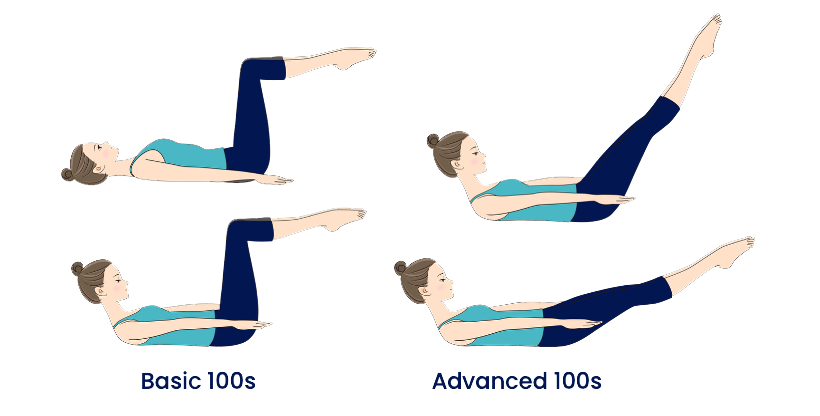
The Hundred (a classic Pilates core warm-up)
This is one of the most recognizable Pilates exercises, and for good reason. It gently wakes up your core, gets your breathing in sync with movement, and looks a lot easier than it feels.
Start by lying on your back with your knees bent in a tabletop position (knees over hips, shins parallel to the floor). Rest your arms long by your sides.
Lift your head, neck, and shoulders slightly off the mat, as if you’re doing a small crunch. At the same time, press your lower back against the mat. You should feel your core engage. Now, raise your arms straight alongside your body, hovering a few inches above the floor.
From here, begin pumping your arms up and down in small, controlled movements. Inhale through your nose for a count of five pumps, then exhale through your mouth for five pumps. That’s one breath cycle.
The goal is to complete ten full breath cycles for a total of 100 arm pumps, which is where the name comes from.
A few helpful notes:
- Keep your lower back gently pressed into the mat. If it starts to arch, bring your knees in closer or rest your head down.
- Think about pulling your ribs down and your core inward, rather than straining your neck.
- If your neck gets tired, it’s fine to lower your head while continuing the arm movements.
- As you get more advanced (or if you already have a strong core), extend your legs straight, instead of tabletop, for this exercise.
You should feel this in your deep core, not just your upper abs. If you’re shaking a little by the end, you’re doing it right.
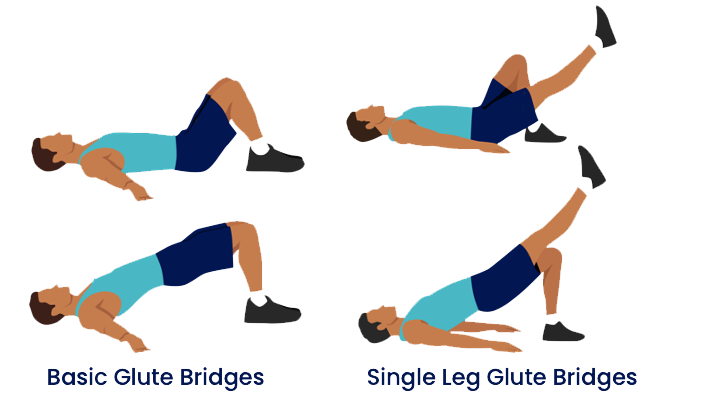
Glute Bridge (with slow, controlled reps)
This is a simple movement that does a lot of important work. It strengthens your glutes and hamstrings while also reinforcing good pelvic stability, which supports your lower back.
Start by lying on your back with your knees bent and feet flat on the floor, about hip-width apart. Your heels should be close enough that you can just brush them with your fingertips.
Rest your arms by your sides and take a moment to find a neutral spine.
Press through your heels and slowly lift your hips off the ground. Think about peeling your spine up one vertebra at a time until your body forms a straight line from your shoulders to your knees.
Pause briefly at the top.
Then lower back down slowly, reversing that same “peeling” motion until your hips return to the mat.
Repeat for 8 to 12 controlled reps.
A few helpful notes:
- Focus on using your glutes, not your lower back, to lift your hips.
- Avoid pushing your ribs up or over-arching at the top.
- Keep your knees aligned over your ankles. Don’t let them fall inward or drift too far apart.
- Slower is better here. The control is what makes it effective.
- For added difficulty, do these using one leg for support at a time. You will definitely feel the burn.
Done well, this should feel steady and controlled, not rushed. It’s one of those exercises that seems basic but delivers real results when you pay attention to the details.
The Bottom Line
Some fitness trends come and go quickly. Pilates has been around for more than a century, and there’s a reason it keeps resurfacing.
It meets people where they are. It supports strength, mobility, and stability at the same time. And it fits into real life, whether you’re trying to improve performance, recover from something, or just feel better in your body. It may be having a moment right now, but it will probably be around for another hundred years.
Pilates is definitely worth a try!
