
Resolutions Fade. Habits Stay. Here’s Why
By now, we’re past that shiny, hopeful part of January.
The planners have been written in. The gym bag has been carried exactly as many times as it’s been carried. And if you made New Year’s resolutions, there’s a good chance you know whether they’re quietly fading… or finally sticking. If you’re like most of us, those resolutions are fading right along with that surge of new year motivation.
But there is still hope for some real 2026 self-improvement. First of all, if something is still happening at the end of January, even inconsistently, that new behavior (or behavior elimination) may already be turning into a habit. And if it’s not? That doesn’t mean you failed. It usually means your New Year’s plan asked for too much, too fast.
Why Resolutions Struggle (and Habits Don’t)
Resolutions tend to be big, dramatic, and vague:
“I’m going to eat better.”
“I’m going to work out more.”
“I’m going to stop doing that thing I probably shouldn’t be doing.”
Habits are the opposite. They’re small, specific, and often a little boring. And boring is exactly what makes them powerful.
Research on habit formation shows that lasting change doesn’t come from motivation or willpower. It comes from repetition, especially repetition that’s tied to something you already do every day. When a behavior fits easily into your existing routine, your brain is much more likely to adopt it and keep it.
In other words: habits don’t need enthusiasm. They need a place to live.
The (Very) Tiny Habit Rule
One of the biggest mistakes people make is resolving to change habits that are simply too big to repeat consistently. An hour-long workout sounds great in theory. In practice, it competes with work, family, fatigue, weather, and real life.
Tiny habits work because they don’t compete with anything.
A two-minute stretch.
Ten squats.
A glass of water.
Writing down one priority for the day.
Taking five slow breaths.
When something feels almost too small to matter, that’s usually the sweet spot. Tiny habits are easy to start, hard to skip, and, over time, surprisingly powerful. When repeated daily, they compound. What feels inconsequential at first often adds up to real change without requiring constant effort or decision-making.
If Your Resolution Isn’t “Taking,” Try This Instead
If you made a resolution that’s been hard to keep, don’t abandon the goal, just shrink the behavior.
Ask yourself:
- What’s the smallest version of this I could do daily?
- Could I do it on my worst, busiest, least-motivated day?
- Can I attach it to something I already do without thinking?
Consistency beats intensity every time. Especially in January, when life has already returned to full speed.
Habit Stacking: Borrowing Strength From What You Already Do
One of the simplest ways to create a habit is to attach it to something you already do every day. This is often called habit stacking, and it works because you’re not creating a brand-new routine—you’re upgrading an existing one.
The formula is simple:
After I do ___, I will do ___.
After I brush my teeth, I’ll stretch for one minute.
After I pour my morning coffee, I’ll drink a full glass of water.
After I sit down at my desk, I’ll write down my top three priorities.
The existing habit becomes the reminder. No alarms. No apps. No extra mental load.
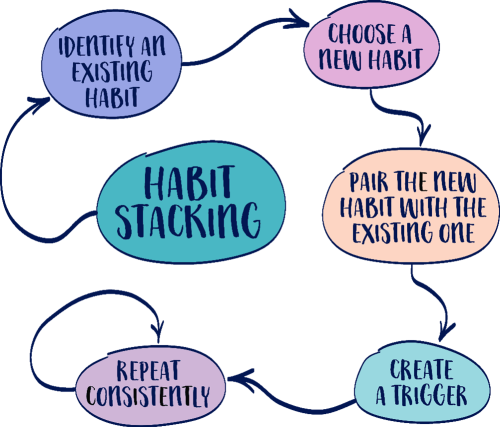
Once a habit feels automatic, you can extend it, or add another small one to the stack. Over time, those small actions begin to change how you feel, how you function, and often how you see yourself. And when you extend them into longer actions, you’re looking at some real change.
There is No Such Thing as a Tiny Habit Failure!
The great thing about tiny habits is that they are easy to maintain. But missing a day is simply a tiny setback as opposed to a major failure. You probably didn’t skip your anchor habit (most of us actually wake up and even brush our teeth or hair every single day). Just re-anchor your tiny habit and start again tomorrow.
Don’t Forget, We’ve Got Your Back
Building habits sounds simple, but it’s not always easy, especially when stress, health concerns, or uncertainty get in the way. If you’re trying to make changes and something isn’t clicking, we’ve got some tools that can help. Log into your Amaze account to checkout our Education Center for healthy habit ideas (nutrition, movement, sleep, stress, and so much more) and, more specifically, our habit courses for a closer look at how to develop them.
