
Superset Me – A Better Workout in Less Time!
If you’ve ever looked around the gym and wondered why some people seem to bounce from one exercise to another without taking a break, they’re probably doing “supersets.”
Although it may sound like gym rat jargon, a superset is a simple training technique that can make your workouts more efficient, more interesting, and in some cases, more effective.
The best part? You don’t have to spend another minute in the gym.
A superset simply means performing two exercises back-to-back with little or no rest between them. Instead of doing a set of biceps curls, resting, then doing another set, you immediately move to a second exercise before taking your break. So, each superset is a combination of “a” and “b” exercises performed with minimal rest (a-b, a-b, a-b).
It is a simple yet powerful concept. The trick is choosing the combination of exercises.
Why Supersets Work
For many people, the biggest obstacle to exercising isn’t motivation. It’s time.
Supersets help solve that problem by replacing much of the downtime between sets with productive work. Using supersets, you can accomplish your full workout in less time. Better still, supersets keep your heart rate elevated, which amps up the cardiovascular benefits of your usual strength-training routine.
Supersets can offer a more powerful workout in a shorter amount of time if you create your sets with care.
How to Create Strong Supersets
Amaze fitness expert Cire Ba recommends creating supersets that pair exercises that use different muscle groups, rather than exhausting the same muscles twice in a row. These fall into one of two categories:
A push-pull superset pairs a pushing movement with a pulling movement. Push-pull supersets are great for reducing your total workout time if you’re performing resistance training for muscle growth. Because you’re using opposing muscle groups, the muscles you engage on your “a” exercise will still get a bit of a rest during your “b” exercise even as your heart rate remains elevated.
By the time you start your second (a-b) set, the muscles used in the first exercise should have had enough recovery time to allow you to perform your next set in good form.
Recent research supports the use of supersets for enhanced training efficiency and reduced training time. However, you may need a bit more rest between training sessions that include supersets due to the increased metabolic demand.
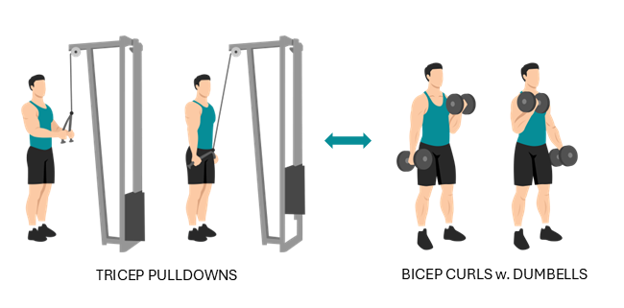
Combining tricep pulldowns with bicep curls is one example of a terrific push-pull superset. You can use the rope attachment on the cable machine for your triceps and keep dumbbells for your biceps at the ready so you can alternate sets.
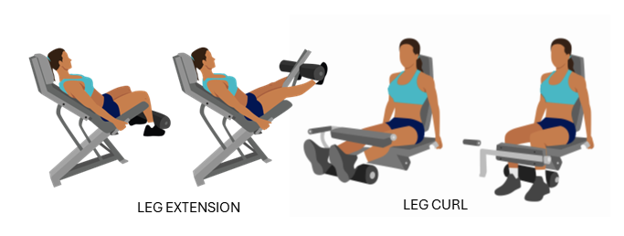
Another excellent push-pull superset combo is leg extensions and leg curls. This only works if you can commandeer both machines at the same time.
An upper-lower-core superset pairs an upper-body exercise with a lower-body exercise, or an upper-body or lower-body exercise with a core exercise. Since the exercises target completely different areas, this is a simple, but effective way to keep your workout moving. While one muscle group is working, the other gets a brief opportunity to recover. That allows you to keep moving without sacrificing as much strength or technique.
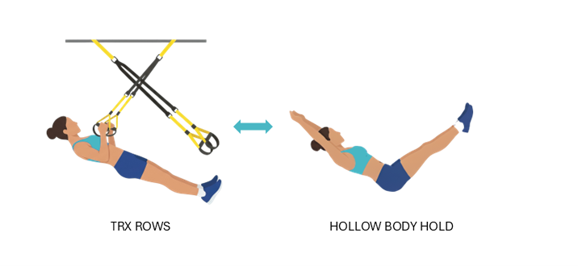
TRX rows for upper body strength can be paired with a core exercise like a hollow body hold for a great upper-core superset. Be creative with sets you already execute. Just be sure the two exercises work different parts of the body.
A Rookie Superset Mistake
Many people assume the hardest workout is automatically the best workout. That’s not always true.
You may see experienced lifters perform a bench press immediately followed by push-ups, or two different shoulder exercises back-to-back. Those are same-muscle supersets, and while they can build muscle by dramatically increasing muscle fatigue, they also make it much harder to maintain good form.
As muscles tire, technique often breaks down. That can mean fewer quality repetitions, and in some cases, a greater chance of injury.
For most exercisers, Cire recommends using supersets to complement your workout — not to completely exhaust a single muscle group. And in any set, if your form starts slipping, lower the weight, reduce the number of repetitions, or take a little more rest between rounds. Quality always beats quantity.
Getting Started
If you’ve never tried supersets, don’t redesign your entire workout overnight. Instead, choose just one or two exercise pairs during your next session.
Start with movements you’re already comfortable performing, especially machine, dumbbell, cable, or bodyweight exercises. Save the heavy, highly technical lifts for when you’re fresh and fully rested.
You’ll probably finish your workout sooner, keep your heart rate up, and discover that waiting around between sets isn’t nearly as necessary as you thought.
Because sometimes the smartest way to improve your workout isn’t doing more. It’s making every minute count.
