
Peace, Love, and the New Science of Healing
It’s summer! That time of year when we find endless reasons to be outdoors and exerting. Maybe we’re taking up beach volleyball or pickleball. Maybe we’re pulling weeds in the garden or building a new toolshed. Maybe we’re hiking or chasing kids/grandkids. Maybe we’re forgetting we’re not teenagers at the company softball game.
More activity inevitably means more injury. Not the serious kind – just the pulls, strains, and serious soreness that remind us that we are more seasonal weekend warriors than professional athletes.
When you feel that pull or twinge or twist or throbbing muscle, what do you reach for? Ice or heat?
For decades the answer seemed simple: Ice.
Every coach, trainer, parent, and PE teacher preached the same advice: RICE – Rest, Ice, Compression, Elevation.
Then something strange happened. Sports medicine researchers started questioning whether icing every injury was, in fact, helping us heal. Some studies even suggested that ice may delay healing.
Holy cow!! Did we all spend the last 40 years icing injuries for no reason? Not exactly. But ice is not always the best answer.
Why We Loved Ice
When you twist an ankle or strain a muscle, your body immediately launches an inflammatory response. Blood vessels leak fluid, the immune system kicks into gear, swelling develops, and pain receptors become extra sensitive.
Ice slows many of those processes. It narrows blood vessels, reduces nerve activity, decreases pain, and limits swelling. That’s why an ice pack often feels almost magical during the first few hours after an injury. It’s reducing inflammation.
The problem is that inflammation isn’t always the enemy.
We’ve spent years talking about reducing inflammation. Sometimes that’s exactly what we want. Reducing inflammation almost always makes us feel better. But inflammation is also how your body begins repairing itself.
Those immune cells arriving at the injury aren’t there by accident. They’re clearing away damaged tissue and releasing chemical signals that tell your body to start rebuilding.
Think of it like firefighters arriving after a house fire. The trucks, hoses, and flashing lights are disruptive, but they’re also the reason the rebuilding can begin.
That principle is why researchers began wondering whether aggressively suppressing the early inflammatory response might also slow recovery. That question eventually led to a major rethink.
Goodbye, RICE!
One of the creators of the original RICE protocol, sports medicine expert, Dr. Gabe Mirkin (still going strong at 91 years old), has acknowledged that the science has evolved. More recent research suggests that while ice is excellent for reducing pain, in some cases, prolonged icing may delay some of the body’s normal repair processes.
That doesn’t mean ice is a bad idea. It depends on your goal. Ice increases comfort, but not the speed of healing.
Today, many sports medicine experts use a newer framework called PEACE, then LOVE. The words represent best advice to patients immediately after injury (PEACE) and during recovery (LOVE). Hokey, yes, but surprisingly useful.
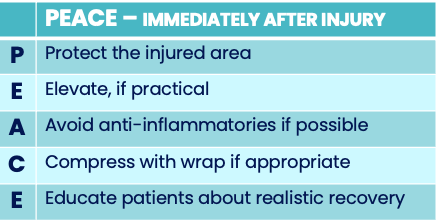
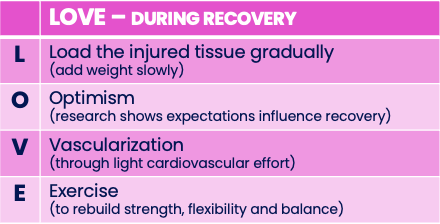
The PEACE and LOVE tools may remind us of a 1960s rock festival, but the advice is based on modern rehabilitation research.
So, When Should You Use Ice?
If an injury is fresh, painful, and swollen, short periods of icing, about 15 to 20 minutes at a time, can help control pain and make it easier to move.
That can be especially helpful during the first 24 to 48 hours. Just don’t expect the ice itself to speed healing. Its biggest benefit is helping you feel better while your body does the real work.
And When Is Heat Better?
Heat works almost the opposite way. Instead of narrowing blood vessels, it opens them. Instead of slowing nerve activity, it relaxes muscles.
Heat increases circulation, improves tissue flexibility, and helps reduce muscle stiffness. Using heat on a brand-new swollen ankle, however, is like pouring gasoline on a campfire. More blood flow can mean more swelling.
Heat is generally best for:
- Tight muscles
- Muscle spasms
- Chronic aches
- Arthritis
- Stiff joints
- Old injuries that no longer have swelling
The Best Treatment Is Something Completely Different
Perhaps the biggest change in sports medicine isn’t about temperature at all. It’s movement!
Years ago, we were told to rest until everything felt “normal.” Now we know that prolonged rest often delays recovery. For many sprains and strains, gentle unweighted movement helps injured tissues heal stronger and more quickly than complete inactivity.
Amaze fitness expert Cire Ba explains that you can speed your recovery by engaging in simple non-weight-bearing range-of-motion movements within 24-48 hours, once sharp pain subsides. Any initial movement should be slow and controlled, not erratic or forced.
The range-of-motion exercise should be pretty intuitive. Rotate your wrist or ankle, bend and straighten your knee or elbow, or roll your shoulder.
Cire cautions that walking or adding weight to a sprained joint should most certainly take longer. For example, you can safely begin walking on a sprained joint or ankle when you can bear your body weight without sharp pain and can walk without a noticeable limp. Until then (about 1-3 weeks), walk with support.
The Bottom Line
If you’re trying to decide between the heating pad and the ice pack, don’t think of one as good and the other as bad.
Think of them as different tools. Ice helps control pain during the early stages of an injury. Heat helps muscles relax and prepares stiff tissues to move.
Your body already has an incredibly sophisticated repair system. The goal is simply to support it.
